Ultraviolet Systems Questions & Answers
Should I shut my system off when I am not using it?
No, the UV system should be left on whether you are using the water or not. The lamps age regardless of the amount of the water drawn through the system. By leaving the unit on, you will eliminate the potential problem of having contamination pass through the system while the unit is off.
Do I need to disinfect my municipal water supply?
Our municipalities work very hard to provide safe, disinfected water for their customers. This is quite evident when you consider the difficulties involved in providing safe drinking water through a vast distribution network. If you use water that comes from a municipal water supply and wish to provide your family with an added "peace of mind", then we believe a UV system acts as an inexpensive insurance policy against the possibility of drinking bacteriologically contaminated water.
Why do I need to disinfect my water supply?
Disinfection is recommended for all water supplies that are not protected by a municipal water source (ex. A private well). Unfortunately, due to the uncertainties that exist with our current water supplies, we can no longer rely on the fact that our water supplies 'may be safe'. By providing your own disinfection, you are taking the responsibility of ensuring the safety of your water supply for you and your family.
How does the UV light actually kill microorganisms?
UV does not kill microorganisms like chlorine does, but instead UV inactivates them. UV light at a specific wavelength of 254 nm is readily absorbed by the genetic material of microorganisms. The DNA strand is coded with a specific sequence of something called base pairs. The sequence of these base pairs codes for certain characteristics. UV light at 254 nm is readily absorbed at the point on the microorganism's DNA strand which codes for reproduction. A microorganism that cannot reproduce, cannot make colonies and therefore cannot infect when consumed. In other words, the microorganisms have been sterilized or neutered. They will eventually die off.
The picture on the left shows a DNA strand of a microorganism. You can see where the UV light is absorbed and how a blockage is formed, causing the microorganism to become sterile.

Does UV inactivate Cryptosporidium (Beaver fever) and Giardia?

Cryptosporidium and Giardia are what is called a protozoan cyst. Protozoa can be described as microscopic, single celled microorganisms which live in water and are quite a bit larger in comparison to other microbes. The majority of protozoan cysts are parasitic. Both Cryptosporidium and Giardia are parasitic. These organisms are in a dormant phase when in water but when they enter a host (being any kind of mammal) they release colonies and begin to breed, ultimately causing severe diarrhea and dehydration over a prolonged period of time.
Cryptosporidium and Giardia were not microorganisms of concern until approximately 10 years ago when Milwaukee was hit with a waterborne disease epidemic. Milwaukee drinking water is surface water, which had become contaminated with high concentrations of Cryptosporidium at the time. Over 100,000 people came down with Cryptosporidiosis and over 400 people died. The USEPA recognized that they needed to consider these organisms and include them within their drinking water guidelines. Testing was done and it was found that chlorine was NOT effective against either of the protozoa. Testing was then conducted using UV technology with initial failure due to improper test procedures. Ultimately it was proven that UV is in fact very effective against Cryptosporidium and Giardia. The dose levels required to inactivate these cysts are actually quite low; less than 10 mJ/cm² for 99.9% reduction of both Cryptosporidium parvum and Giardia lamblia.

Will a UV system kill all microorganisms in my water?
All Sterilight systems are rated for a 4-log inactivation of bacteria, viruses and protozoan cysts under specific conditions. This rating is at a specific flow rate, and water quality. It is a good idea to have your water microbiologically tested prior to installing a UV system. We do suggest that if your water has bacteria counts in excess of 1000 CFU/10 mL that you do a bit of research with regards to what could be causing such high bacteria counts and that you oversize your UV in order to ensure a high UV dose being delivered to your water supply.
Microorganism Destruction Chart
Is UV effective against E. coli?
Yes, E. coli requires a UV dose of between 6 -10 mJ/cm² to achieve a 4-log inactivation. This is well within the capabilities of Sterilight UV systems.
How do I clean the quartz sleeve?
If the quartz becomes stained, remove the sleeve from the reactor chamber and clean the OUTSIDE with a commercially available scale remover, such as Lime-Away or CLR. If the inside of the quartz sleeve does become wet, ensure that it is thoroughly dried before putting the Sterilight system back together.
My lamp is still glowing blue; do I still need to replace it?
The UV light that is inactivating microorganisms in water is non-visible light, therefore the blue light that you see coming off a UV lamp is not what's doing the work. A UV lamp can be described as a low pressure mercury vapor lamp, which means it fires via mercury vapor. Over the course of a year that mercury is being used up resulting in a slight decrease of UV intensity. At the end of one year a Sterilight UV lamp has decreased in it's intensity by approximately 20%. We strongly recommend that UV lamps be changed on an annual basis.
What is recommended maintenance for a UV System?
Sterilight UV systems require the lamp to be changed on an annual basis (provide they are not installed in a seasonal home). It is suggested that the quartz sleeve be cleaned during the lamp change provided the home is supplied with high quality water (no iron, hardness etc.) otherwise the sleeve should be maintained on a regular basis.
Please NOTE: If the Sterilight system you have is monitored (ie. Has a sensor) you must ensure that you clean the sensor eye as well as the quartz sleeve.
All new lamps come with a pair of o-rings. Please replace existing o-rings with the new ones.
Is UV light harmful?
You never want to expose your skin or eyes to the light from a UV system. UV light is non-visible however it can be harmful, similar to the harmful effects of UV light from the sun. UV lamps can actually cause a severe sunburn-like effect if skin is exposed for long periods of time.
Always ensure that you are wearing some type of protective glasses (ie. Safety glasses or sunglasses) when working on a UV system and the lamp is exposed. You want to make sure that you do not touch the UV lamp with your fingers as the oil from your hands will form a residue on the lamp and can potentially block UV light.
What does "log inactivation" mean?
Log inactivation is the inactivation of microorganisms on a logarithmic scale. Microorganisms must be considered on a logarithmic scale due to their high numbers.
What is UV dose?
UV dose is the energy that is coming off the UV lamp over a specific time period. Therefore, UV dose (or fluence) is a product of UV intensity and time. Dose is usually measured in milli joules per square centimeter. Each Sterilight system is rated to disinfect your water at specific flowrate, under specific water quality conditions to give a UV dose of 30 mJ/cm2 at the end of the lamp life (which is one year).
If you were to run say 10 USGPM through a 5 USGPM Sterilight system (ie. S5Q-PA) then you would only be receiving HALF the dose that the system is rated at because you doubled the flow. It works the other way as well. If you were to have a 12 USGPM Sterilight system installed (ie. S12Q-PA) but you were only running 6 USGPM through it then you would be receiving double the UV dose as you are increasing the water's exposure time to the UV light.
The UV industry standard for dose is 30 mJ/cm2 at the end of lamp life (EOL) however different validation protocols will specify different dose values. Please refer to the
compliance page for more information on the various validation dose requirements.
What is UV light?
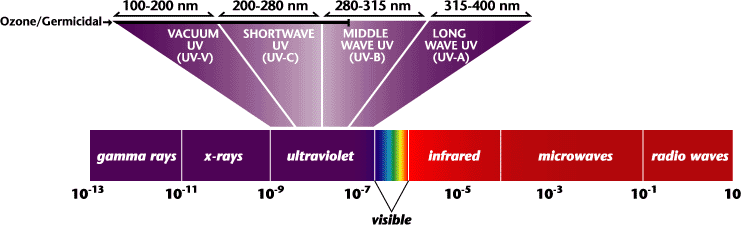
UV light is part of the electromagnetic spectrum, shining at a specific wavelength.
All light is given off at different wavelengths. For example if you see a rainbow, you will notice that the colors are always in a specific order from red all the way to blue. You are able to see each color due to their individual wavelength. These wavelengths are part of the visible portion of the electromagnetic spectrum.
UV light is at a wavelength of 254nm (nanometers), and is not visible to the naked eye. This portion of the electromagnetic spectrum is termed UV-C light or a germicidal wavelength. At this 254nm microorganisms undergo a genetic alteration which ultimately results in inactivation. Below is a representation of the electrospectrum:
UV System manufacturers are able to harness this wavelength of light in UV lamps, which will ultimately disinfect your water.
Will UV change the taste and/or odor of my water?
No. With chemical disinfection, such as chlorination, the taste and odor of your water will change (depending on chlorine levels water can smell and taste of bleach) and disinfection by-products will be produced. A few examples of chemical disinfection by-products (DBP) are trihalomethanes and haloacetic acid. Both of these DBP's can be carcinogenic when ingested at high levels. The pH and conductivity of drinking water also changes when chlorine is added.
UV is a physical type of disinfection. This means that the UV will have an effect on the microorganisms in the water only. The water will not change chemically, nor will the taste and odor change. The water may elevate in temperature if the water has been left stagnant in the UV reactor (ie. During times of little or no use - during the night).
I have colour in my water causing a low UVT, how do I remove it?
If you have high colour in your water it is most likely a concentration of tannins. High tannin levels are found in most surface water supplies and some groundwater or simply in waters where large quantities of vegetation have decayed. Unfortunately tannins cannot simply be removed from water by a physical means of filtration.
Tannins can be described as a colloidal suspension as it carries a negative charge and therefore will not simply fall out of solution like turbidity does. Tannins are water soluble, organic compounds formed in the decomposition of organics. It can cause a slight yellowish color to the water and will rapidly decrease the level of UVT in your water as the tannin level increases.
The most efficient way to remove tannins from drinking water is by way of an anion exchange system. Hardness is removed from water via a cation exchange system or softener, as the hardness compounds need to be exchanged with sodium ions in order for the hardness to be removed. Tannin removal systems work the same way but with a slightly different resin than a softener. Softeners exchange cations for cations (positively charged ions, like calcium and magnesium in exchange for sodium ions) and tannin removal systems exchange anions for anions (negatively charged ions like tannins in exchange for chloride ions).
What is UVT?
UV transmittance at 254 nm (which is the wavelength of light that UV lamps operate at) is a measure of the fraction of incident light transmitted through the water column. The UV transmittance is the ratio of the light entering the water to that exiting the water. The UVT is usually reported for a pathlength of 1 cm. As UV absorbance increases, the UV transmittance decreases (USEPA UVDGM 2003).
UVT is measured using a spectrophotometer. High levels of color &/or tannins will cause a decrease in the UVT level. If the water cannot transmit the UV light, than the UV cannot disinfect efficiently
Does my water require pretreatment before my UV?
Yes, you must have your water tested prior to installing a UV systems. Many people feel that if they can fill a glass with water and the water looks clear then that must mean that it is. This is not true. There is more to water than what the naked eye can see. Water flowing through a UV system needs to be free from hardness, iron, turbidity, manganese and color (which can be called tannins). The following is what R-Can recommends for the Sterilight UV systems:
Hardness < 7 gpg (grains per gallon)
Iron < 0.3 ppm (parts per million)
Manganese < 0.05 ppm
Turbidity < 1 NTU
UVT > 75%
Tannins < 0.1 ppm
If these levels are exceeded scaling can occur, causing a decrease in the UV system's efficiency as well as an alarm condition if the system is monitored. We always recommend to our customers that they install a 5 micron filter prior to the UV in order to knock down any turbidity that may be present in the water.
We do recommend that if you are drawing from a lake or from some other SURFACE water supply (lakes, rivers, dug well etc.) that a water analysis is ALWAYS done prior to the installation of a UV.
How do I disinfect water lines in my home?
A UV system is there to protect your water from pathogenic microorganisms, BUT there is the potential for harmful microorganisms to already be present in the water lines. The water lines then need to be disinfected upon installation of the UV system.
A simple way to introduce a disinfectant (chlorine) into the lines is via the filter. Once the Sterilight system has been plumbed in simply remove the cartridge from the filter housing and fill the housing halfway with household bleach (bleach contains 5.25% chlorine). With the Sterilight system ON, turn the water on and ensure that at each and every tap a chlorine smell is detected. Leave the bleach in the lines for at least one hour. Drain the chlorine from the lines.
Detailed Disinfection Procedure
What is a solenoid valve and can I hook one up to a UV System?
A solenoid valve is an electrically-activated mechanical valve that opens and closes when power is applied to it. This kind of valve can be installed and wired into a Sterilight system which is monitored. If the UV intensity were to drop below the recommended level the solenoid would then be activated and automatically shut down the flow of water. This will keep contaminated water from getting through the UV system. A solenoid can be hooked up to a Sterilight system either by dry contacts (the Platinum, SUV and SUVAM systems all come equipped with dry contacts), or directly into the Sterilight system (Silver and GOLD series can be hooked up directly to a solenoid; outside power does NOT need to be brought to the solenoid).
Where do I install UV in relation to other treatment equipment?
The UV must be the very LAST piece of water treatment equipment.
Will a UV system restrict my water pressure?
No, Sterilight systems are designed with inlet/outlet ports correctly sized for the specific application. As an example, the 8 USGPM system comes with 3/4" ports. The typical pressure drop on this system would be 2-3 psi.
Will UV change the taste and/or odor of my water?
No. With chemical disinfection, such as chlorination, the taste and odor of your water will change (depending on chlorine levels water can smell and taste of bleach) and disinfection by-products will be produced. A few examples of chemical disinfection by-products (DBP) are trihalomethanes and haloacetic acid. Both of these DBP's can be carcinogenic when ingested at high levels. The pH and conductivity of drinking water also changes when chlorine is added.
UV is a physical type of disinfection. This means that the UV will have an effect on the microorganisms in the water only. The water will not change chemically, nor will the taste and odor change. The water may elevate in temperature if the water has been left stagnant in the UV reactor (ie. During times of little or no use - during the night).
What UV dose is considered sufficient to remove viruses from water supply? I see your
Sterilight units and/or the US industry standard dose = rated at 30mJ/cm2 at EOL. I can't find the 'compliance page' that is referred to in your Q&A "What is UV dose".
Target
Pathogens
|
Log Inactivation
|
| 0.5 | 1.0 | 1.5 | 2.0 | 2.5 | 3.0 | 3.5 | 4.0 |
|
Cryptosporidium
| 1.6 | 2.5 | 3.9 | 5.8 | 8.5 | 12 | 15 | 22 |
|
Giardia
| 1.5 | 2.1 | 3.0 | 5.2 | 7.7 | 11 | 15 | 22 |
|
Virus
| 39 | 58 | 79 | 100 | 121 | 143 | 163 | 186 |


